
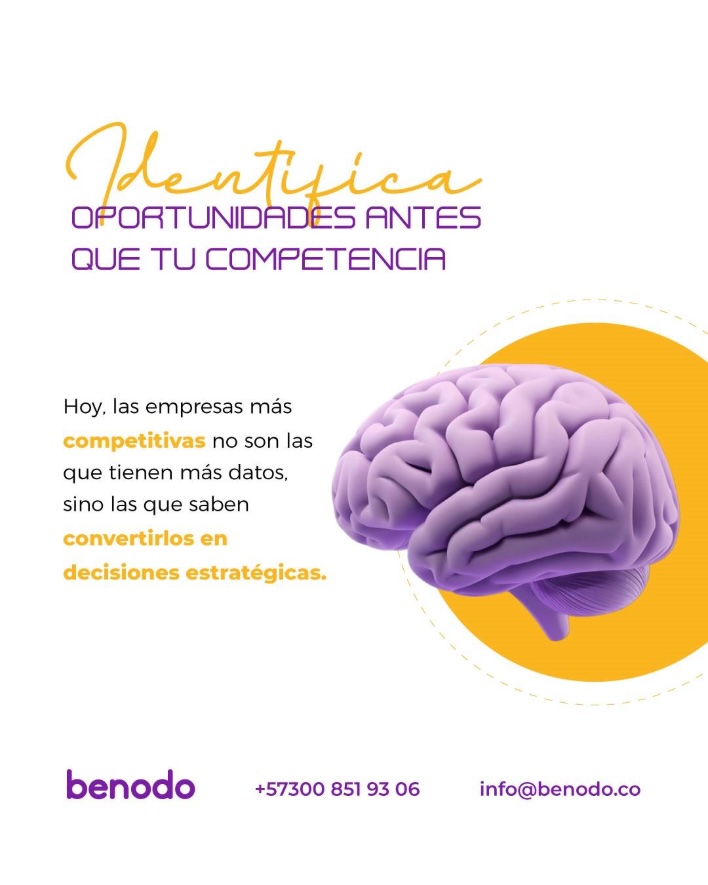
Most companies generate more data than ever, but fewer turn it into strategic information for business decisions. Moving from intuition alone to a data-driven organization helps businesses respond to a changing market.
At Benodo, we believe the future of business includes using data intelligently, and we support organizations on that journey.
What does being data-driven really mean?
A data-driven company bases decisions on evidence and analysis rather than relying solely on experience, intuition or hierarchy.
This involves more than dashboards or reports. Data becomes a strategic asset guiding:
- Sales and marketing planning.
- Supply-chain optimization.
- Customer management and experience.
- Product and service innovation.
- Operational efficiency.
Data moves from being an operational byproduct to informing business strategy.
The pillars of a data-driven organization
- Data quality: without clean, reliable and well-structured data, analysis loses value. Governance, standardization and deduplication are important.
- Technology infrastructure: cloud platforms, scalable databases, integration of heterogeneous sources and analysis tools.
- Advanced analytics and AI: moving beyond descriptive reports to evaluate predictive and prescriptive approaches that anticipate scenarios and suggest actions.
- Organizational culture: one of the hardest changes is cultural. Each department needs to trust the data and use it to support decisions.
- Security and compliance: manage information according to applicable privacy and security requirements, including GDPR and local rules where relevant.
Potential business benefits
- Lower operating costs through automation and evidence-based optimization.
- Revenue opportunities from identifying consumption patterns and personalizing experiences.
- Strategic agility in responding to market changes.
- Continuous innovation as data reveals previously overlooked opportunities.
- Better customer relationships through deeper understanding and segmentation.
The original article cites a McKinsey study reporting higher likelihoods of customer acquisition, retention and profitability among data-driven organizations. Those comparisons provide historical context; they are not a promise of results for a particular company.
Data-driven trends to understand
- Data mesh and democratization: business areas manage and share their data as a product.
- Generative AI integration: models can support explanations and proposals alongside analysis, subject to validation.
- Low-code/no-code automation: technologies such as Oracle APEX can make information more accessible without making every task depend entirely on IT.
- Cloud-first and multicloud: data operates across flexible, distributed environments.
- AI ethics and trust: transparency and explainability matter alongside the algorithms.
How Benodo supports the journey
At Benodo, we help organizations:
- Modernize databases and migrate them to scalable cloud architectures.
- Implement dashboards and dynamic reporting.
- Develop advanced analytics and predictive AI approaches.
- Design data governance and quality strategies.
- Prepare teams to adopt a data-driven culture.
Our approach combines technology, strategy and guidance so data can become a competitive asset.
From data to decisions
Becoming data-driven takes time. Each step can help the business become more agile and informed. Where intuition alone is insufficient, data offers a direction for decisions.
Is your organization making full use of its data? Discuss the next step with Benodo.
